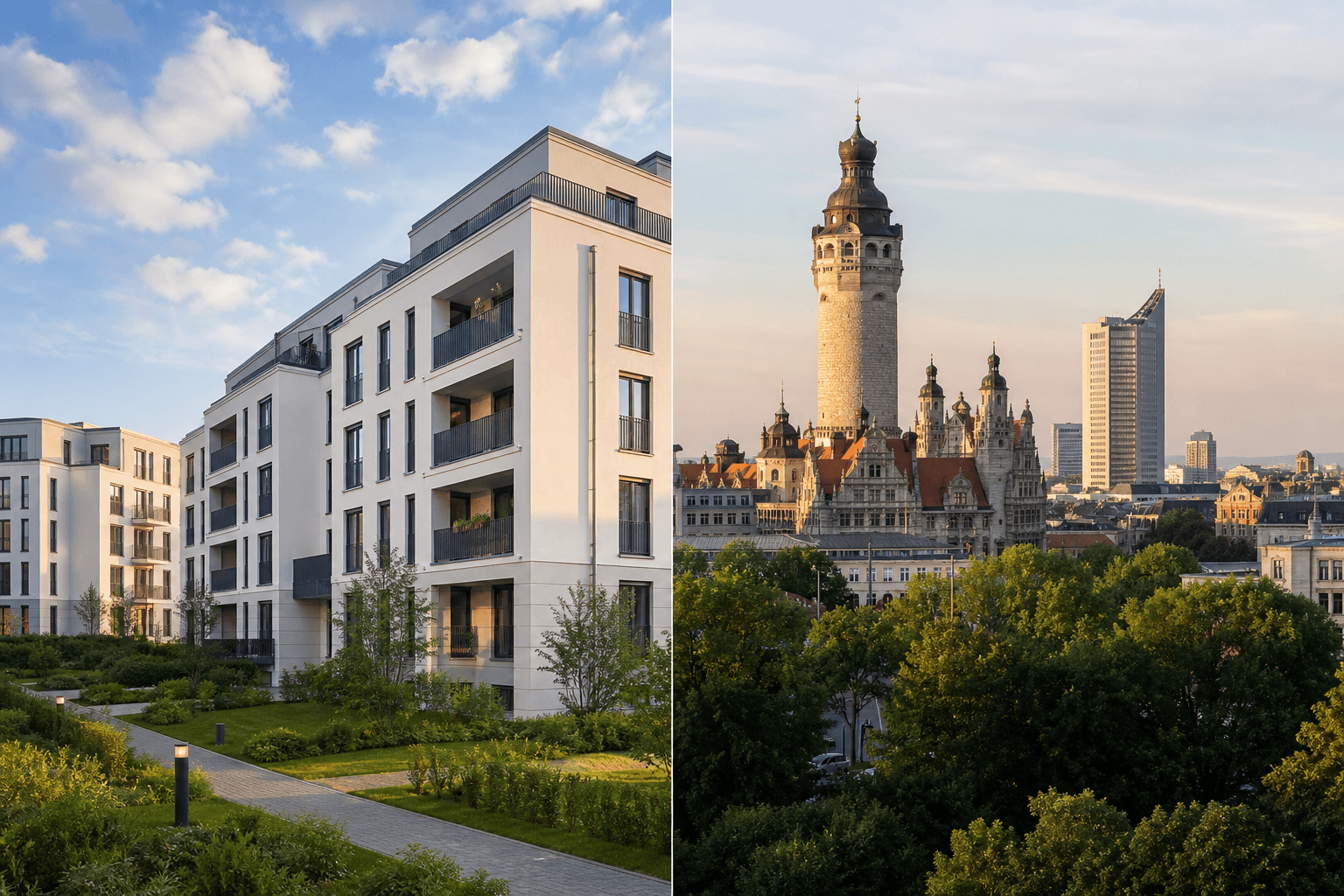
Dresden or Leipzig: Where Is Property Investment More Worthwhile in 2026?
Compare Grunderwerbsteuer Sachsen 2026, price-to-rent ratios, and investment potential in Dresden vs Leipzig for informed decisions.
InvestBud Team
Investment Analysts
Grunderwerbsteuer Sachsen 2026: A Starting Point for Cost Comparison
In my analysis of over 200 properties in Saxony, the Grunderwerbsteuer Sachsen 2026 rate remains fixed at 3.5%. This purchase tax affects both Dresden and Leipzig equally, but its impact varies with property prices.
For instance, a typical apartment in Dresden costs around EUR 3,600 per sqm, while in Leipzig, prices average EUR 3,100 per sqm. Thus, the purchase tax on a 70 sqm flat is EUR 8,820 in Dresden versus EUR 7,595 in Leipzig.
Test this investment idea on your own address
Pick a location and enter the purchase price. We'll prepare rental yield, cash flow, tax impact, and the cost breakdown as a private report.
Understanding this baseline helps you weigh ancillary costs alongside rental yields and price trends in these two key cities.
Price-to-Rent Ratio: Which City Offers Better Rental Value?
The price-to-rent ratio is crucial for investors seeking steady cash flow. In Dresden, average monthly rents hover around EUR 11.50 per sqm, equating to EUR 805 for a 70 sqm unit. Leipzig offers slightly lower rents at EUR 10.20 per sqm, or roughly EUR 715 monthly.
Calculating the gross rental yield: Dresden's EUR 274,000 purchase price yields about 3.5% annually, while Leipzig’s EUR 217,000 property offers closer to 4.0%. This suggests Leipzig delivers a better rental return on investment.
but, rental growth prospects differ, with Dresden’s market traditionally more stable and Leipzig showing faster appreciation in recent years.
Dresden price per sqm: EUR 3,600
Leipzig price per sqm: EUR 3,100
Dresden gross rental yield: ~3.5%
Leipzig gross rental yield: ~4.0%
Investor Pros and Cons: Dresden vs Leipzig
From my personal experience, Dresden offers a mature market with lower vacancy rates around 3%. This means less risk of rental gaps, making it suitable for risk-averse investors prioritizing steady income.
Leipzig, on the other hand, attracts younger tenants and enjoys higher population growth but has slightly higher vacancy rates near 5%. Its growth potential is attractive if you are comfortable with moderate risk.
Tax-wise, both cities share the same Grunderwerbsteuer Sachsen 2026 rate, but you should also consider property management costs, local regulations like the Mietpreisbremse, and potential for AfA depreciation benefits.
Dresden: stable rents, lower vacancy, higher purchase prices
Leipzig: higher yields, faster appreciation, moderate vacancy
Both cities: 3.5% Grunderwerbsteuer Sachsen 2026
Consider local rental regulations and property taxes
Clear Recommendations Based on Investor Profiles
If you aim for long-term capital preservation with steady rental income, Dresden’s established market is preferable despite the higher initial cost.
For investors focused on maximizing yield with potential for capital gains, Leipzig offers a compelling opportunity with lower purchase prices and better rental yields.
A property I recently analyzed in Leipzig showed a 4.3% net yield after factoring in ancillary costs and vacancy, outperforming comparable Dresden properties by nearly 0.8%.
Check detailed city insights on Saxony, Dresden, and Leipzig to tailor your investment strategy.
Frequently Asked Questions
What is the current Grunderwerbsteuer rate in Saxony for 2026?
The Grunderwerbsteuer Sachsen 2026 remains at 3.5% of the purchase price. This rate applies uniformly to all property purchases in Saxony, including both Dresden and Leipzig.
How do property prices in Dresden and Leipzig compare in 2026?
Dresden’s average price per sqm is around EUR 3,600 while Leipzig’s is approximately EUR 3,100. This results in a roughly 16% lower entry price in Leipzig for comparable properties.
Which city offers better rental yields for investors?
Leipzig generally offers higher gross rental yields of about 4.0%, compared to Dresden’s 3.5%. but, Dresden tends to have more stable rental income and lower vacancy rates.
Are there differences in tenant demand between Dresden and Leipzig?
Yes. Dresden has a mature tenant base with lower vacancy, while Leipzig attracts younger renters and grows faster but with slightly higher vacancy, which may impact short-term rental income.
How should I factor in ancillary costs beyond the Grunderwerbsteuer Sachsen 2026?
Ancillary costs including notary fees, land registry, and agent commissions typically add around 10-12% on top of the purchase price. These should be included in your total investment calculation for both cities.
Calculate your investment potential in Dresden or Leipzig with our detailed Investbud calculators and make informed decisions.
Written by
InvestBud Team
Our team of investment analysts brings you data-driven insights on the German real estate market. We combine financial expertise with local market knowledge to help you make smarter investment decisions.
Test this investment idea on your own address
Pick a location and enter the purchase price. We'll prepare rental yield, cash flow, tax impact, and the cost breakdown as a private report.
Continue Reading
More Insights
Repayment 1, 2 or 3 Percent: The Right Strategy for Your Investment Property
Compare repayment rates of 1%, 2% and 3% for investment properties with concrete numbers, interest calculations, use financing examples and bank negotiation tips.
What Is an Annuitized Mortgage? Simply Explained for Property Investors
Annuitized mortgage explained for investors: learn how the fixed payment splits into interest and principal, see concrete calculations, and use practical tools.
How Much Equity Do You Really Need for Property Investment in 2026?
Concrete financing advice for 2026: exact interest and repayment calculations, equity-debt examples, and steps to improve bank conditions for property investments.